Multimodal Foundation Models Move From Narrow Tools to General-Purpose Scientific Reasoning Systems
Research institutions are shifting away from single-purpose machine learning models toward multimodal foundation models that unify structure, sequence, imaging, and text into one representation — a pattern now visible across materials science, molecular biology, and cell biology alike.
The story
Machine learning in the physical and life sciences has historically been narrow by necessity: a model trained to predict one material property, or one class of protein interaction, using one data modality. That is changing. Across materials science, chemistry, and biology, research groups are converging on the same architectural idea — train one foundation model on many modalities at once, and let it transfer across tasks it was never explicitly trained for.
In materials science, researchers at MIT introduced MultiMat, a framework for self-supervised multimodal training on data from the Materials Project database. Rather than learning a single structure-to-property mapping, MultiMat trains across multiple axes of material data simultaneously, and the resulting shared representation space allows the model to screen for novel stable materials via latent-space similarity — a capability that single-modality models don't have. The approach achieved state-of-the-art results on established material-property prediction benchmarks.
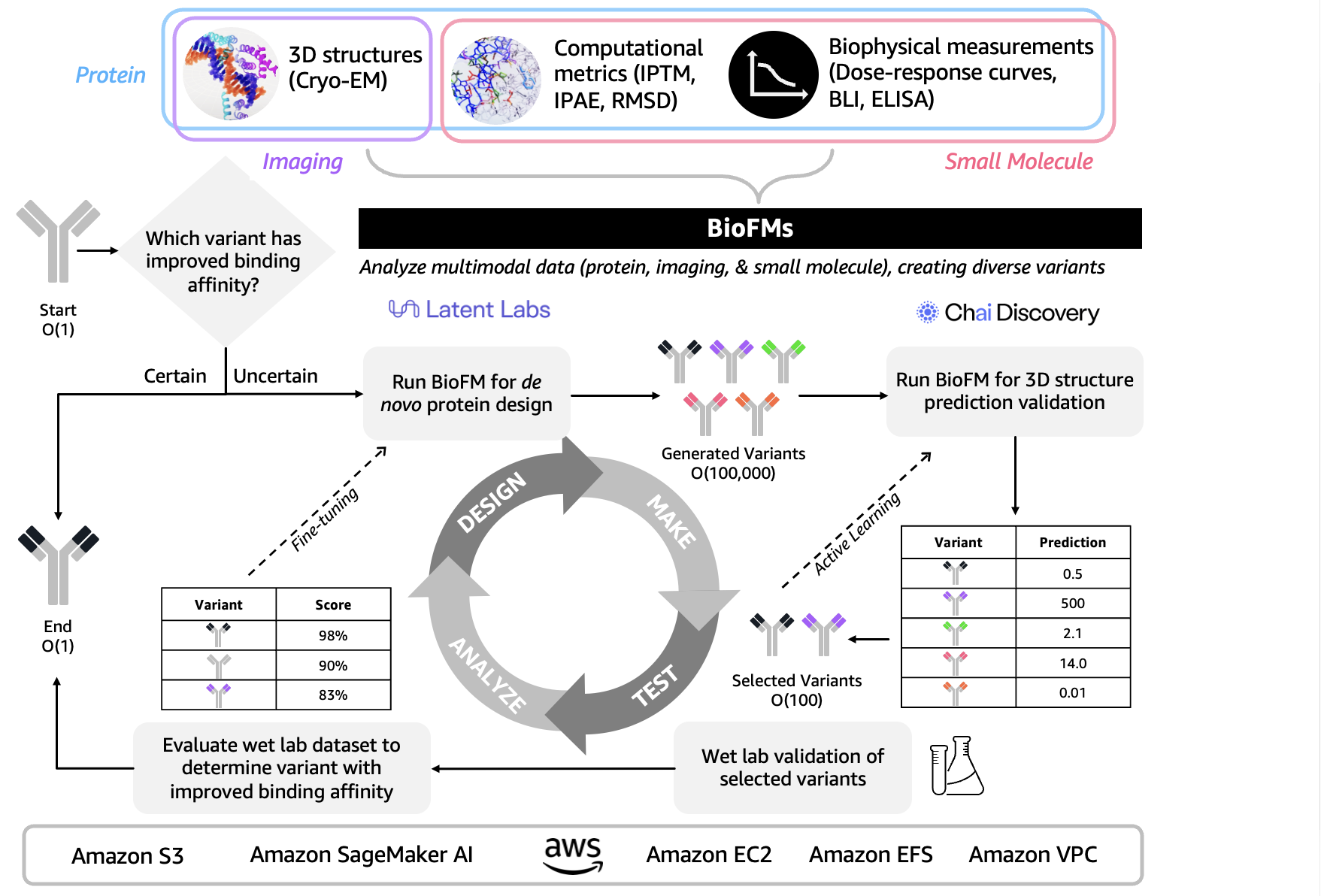
The pattern repeats in the life sciences at larger scale. A recent AWS overview of multimodal biological foundation models (BioFMs) notes that current models are already unevenly but broadly deployed: roughly 20% of applications concentrate on protein structure and molecule design, 30% on omics data (DNA, epigenetics, RNA), 15% on medical imaging, and 35% on clinical documentation.
Single-cell biology is undergoing a related shift, with a 2026 Cell Systems perspective describing a move from modality-specific models toward "compositional" foundation models that unify chromatin accessibility, protein abundance, spatial transcriptomics, microscopy, and text annotations into one cellular representation — explicitly framed as a response to the limits of single-modality models trained in isolation.
Drug discovery is where the trend is most mature. A 2026 review in Molecular Informatics describes how foundation and multimodal models are becoming core methodology in molecular informatics: large-scale pretraining on chemical and biological corpora now supports transfer learning across property prediction (QSAR/ADMET), virtual screening, reactivity prediction, and generative molecular design, with protein language models supplying structural context that integrates directly with ligand-based multimodal pipelines.
The field has matured enough that ICML 2026 is hosting its third dedicated workshop on multimodal foundation models for the life sciences — itself a signal that this has moved from a handful of papers to an established subfield with its own recurring venue. The common thread across materials, cell biology, and drug discovery is the same: institutions are betting that one well-trained multimodal model, adapted to a new task, will outperform a purpose-built single-modality model trained from scratch.
Key takeaways
MultiMat (MIT) demonstrates that self-supervised multimodal pretraining on materials data beats single-modality models on standard property-prediction benchmarks.
Multimodal biological foundation models already span protein design, omics, medical imaging, and clinical documentation, per an AWS applied-AI review.
Cell biology is moving toward “compositional” multimodal models that unify five or more distinct measurement types into one representation.
Molecular informatics research now treats multimodal pretraining as core methodology for drug discovery, not an experimental add-on.
ICML's third dedicated workshop on the topic (2026) signals the field has moved from novelty to established subfield.
References
Cell Press (Newton) — “Multimodal foundation models for material property prediction and discovery” (Feb 2025). Read more →
AWS Machine Learning Blog — “Applying multimodal biological foundation models across therapeutics and patient care” (Apr 2026). Read more →
Cell Systems — “From modality-specific to compositional foundation models for cell biology” (Feb 2026). Read more →
Molecular Informatics (Wiley) — “Foundation and Multimodal Models for Drug Discovery in Molecular Informatics: Principles, Evaluation, and Practical Guidance” (2026). Read more →
ICML 2026 — “3rd Workshop on Multi-modal Foundation Models and Large Language Models for Life Sciences.” Read more →