Long-Horizon Reasoning Is Still Agentic AI's Hardest Problem — New Benchmarks Show How Far Research Agents Have to Go
As agentic systems get deployed against real scientific workflows, a wave of new benchmarks is converging on the same finding: agents that perform well on general browsing and coding tasks fall apart the moment a task requires sustained, multi-step reasoning over dozens of interdependent steps.
The story
Long-horizon reasoning — the ability of an AI agent to plan, act, observe, and revise a strategy coherently across dozens or hundreds of steps — has become one of the most closely watched open problems in agentic AI research, precisely because it is the capability that separates a useful research assistant from a system that can only handle short, well-scoped tasks.
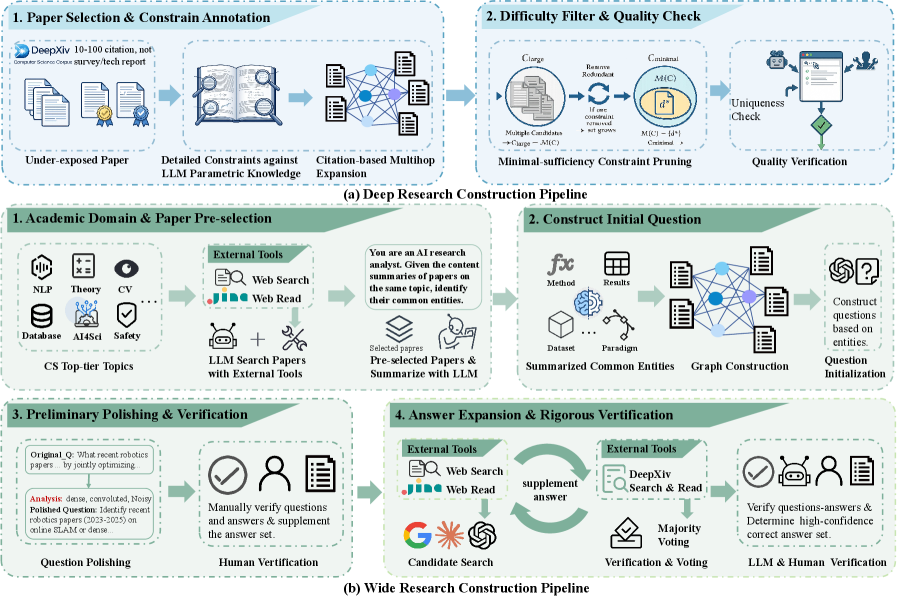
The clearest evidence comes from AutoResearchBench, a 2026 benchmark built over more than three million arXiv papers to test whether agents can conduct open-ended scientific literature discovery — deciding what to search for, when to stop, and when to abstain because no answer exists. Frontier models that perform strongly on general-purpose browsing benchmarks like BrowseComp collapse on this task: the best systems achieve only 9.39% accuracy on the benchmark's "Deep Research" track and 9.31% on its "Wide Research" track, with many strong baselines scoring below 5%.
The authors describe this as a distinct capability gap that general browsing benchmarks simply don't capture.
Related work on WebAnchor identifies a specific failure mechanism: the first step of a long-horizon plan carries disproportionate weight. An error in that first planning step can reduce an agent's success rate by up to 30 percentage points downstream, because the agent has no reliable mechanism for detecting and recovering from an early misstep. A proposed fix — anchoring reinforcement learning rewards specifically to the quality of the first plan step — outperforms uniform reward strategies, but remains a research mitigation rather than a solved problem.
Architecture-level work tells a similar story. COMPASS, a hierarchical agent design that separates context curation, strategic meta-thinking, and tactical execution into distinct components, shows gains of up to 20 percentage points on long-horizon tasks — but ablation studies show that removing either the context manager or the meta-thinking layer causes the agent to fall back into blind repetition or runaway token usage.
Separately, CubeBench finds that agents struggle to maintain or reconstruct a global sense of state from partial observations, even in deterministic, single-object tasks — a memory and perception bottleneck that shows up well before an agent even reaches the reasoning-heavy part of a task. The current benchmark landscape doesn't support a narrative of agentic systems having "mastered" long-horizon scientific reasoning. Long-horizon coherence remains the central open problem in agentic AI research right now.
Key takeaways
AutoResearchBench shows frontier agents scoring under 10% on open-ended scientific literature research, despite strong performance on general web-browsing benchmarks.
A single flawed first planning step can cut an agent's task success rate by up to 30 percentage points (WebAnchor).
Hierarchical architectures like COMPASS show up to +20pp gains on long-horizon tasks, but the gains are fragile and collapse under ablation.
Memory and state-tracking failures (CubeBench) appear even in simple, deterministic tasks — before reasoning difficulty is even a factor.
The research consensus as of early 2026 treats long-horizon reasoning as an unsolved, actively worked problem — not a demonstrated capability.
References
arXiv — “AutoResearchBench: Benchmarking AI Agents on Complex Scientific Literature Discovery” (Apr 2026). Read more →
Emergent Mind — “Long-Horizon Reasoning Benchmarks” (Jan 2026), summarizing COMPASS, Anchor-GRPO, CubeBench, and related work. Read more →
arXiv — “WebAnchor: Anchoring Agent Planning to Stabilize Long-Horizon Web Reasoning” (Jan 2026). Read more →
arXiv — “AMA-Bench: Evaluating Long-Horizon Memory for Agentic Applications” (Feb 2026). Read more →
arXiv — “InquiTree: Evaluating AI Agents in the Scientific Inquiry Loop with Paper-Derived Research Trees.” Read more →